

What is it?
The ozone layer is a shield of gas that protects the earth from most of the sun’s harmful ultraviolet radiation. It absorbs around 90% of these rays, shielding whole ecosystems, including humans, from sun damage. It is made up of the reactive molecule ozone, made of 3 oxygen atoms. This layer is located in the stratosphere, around 15 – 50km above Earth, keeping us and all animals safe.
What Happened?
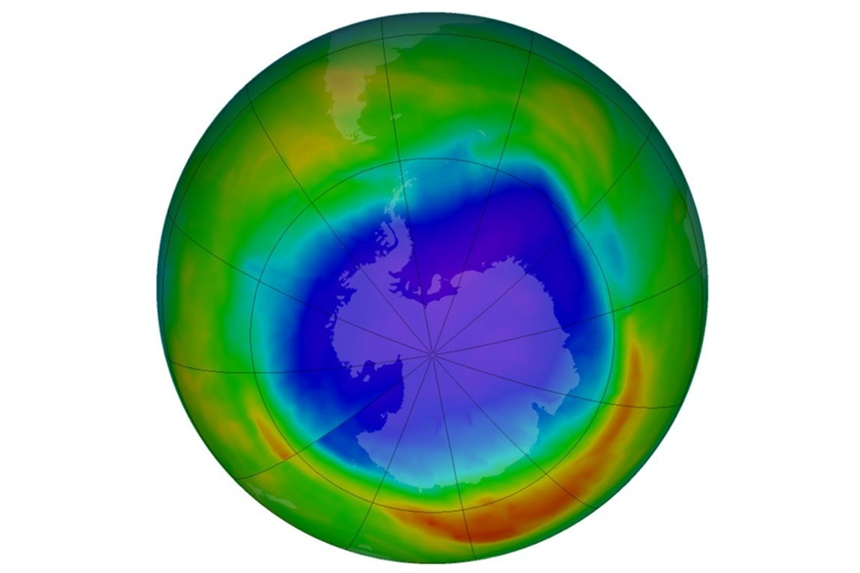
The ozone layer started thinning during the 1970s, over Antarctica. What was classified as a large-scale depletion of ozone concentrations was discovered by British Antarctic Survey scientists, detailed in their published findings from 1985. This “hole” was a massive thinning of around 30 million square kilometers at its largest.
Cause
Shortly, the use of refrigeration, air conditioning, and aerosol sprays (which had the man-made chemicals chlorofluorocarbons (aka CFCs)) began breaking down the molecules of ozone in the stratosphere. Specifically, CFCs rise and are broken down by UV rays, releasing chlorine atoms. To put that into perspective, “one chlorine atom can break down over 100,000 ozone molecules,” (Global Monitoring Laboratory). This “breaking down” was concentrated over Antarctica because of the drastic cold and weather patterns present there. The extremely low temperatures form clouds, which support the activation of chlorine.
What if it had kept growing?
If the hole in the ozone layer had not begun to repair itself and it still grew today, the effects would be detrimental to our environment (not just in Antarctica where it originated). As mentioned, the ozone layer protects us by absorbing harmful ultraviolet light. With a larger leak, the UV radiation on the earth’s surface would be much higher, increasing risk of skin cancers, cataracts and eye damage, and human immune system suppression. There would be a collapse of ecosystems, particularly oceanic food webs that are based on phytoplankton which are highly sensitive to UV radiation. Removing this food source would cause catastrophic collapses of food chains for marine life. Agriculture would be harmed since many essential crops such as rice, wheat, and soybeans are vulnerable to the radiation. The world around us would begin to crumble (literally). This exposure would lead to material degradation since the radiation would break down infrastructure and daily products more rapidly. Continued damage would have altered weather patterns.
If nothing had been done by the mid-21st century, UV levels would have doubled and reached staggering numbers. Going outside would have been a hazard and whole ecosystems would be destabilized.
Regeneration
The 1987 Montreal Protocol chartered by the United Nations banned the use of CFCs. Specifically, 99% of these harmful substances. By this treaty, all member states of the U.N. would allow the ozone layer to naturally begin to regenerate. It slowly decreased the concentration of ozone depleting substances in the stratosphere. It is widely considered the most successful protocol for the environment in human history, which is proof that such things are possible.
Predictions for the Future
Thankfully, the breach in the ozone layer remains, slowly shrinking although its size varies depending on weather (as seen with extreme cold and wind). It is predicted to return to its normal level (seen in 1980) globally by 2040, and in Antarctica by 2066. The maximum size the hole reached was 28.2 million square kilometers. Currently, it is measured at 22.86 million square kilometers.
Good News!
This is a true example of what can happen when global leaders come together and act against mass-producing environmentally harming substances. The ozone layer is planned to make a full recovery. It was truly close call.
The government’s influence on environmental issues is too great to ignore. This shows that applying regulations to companies and dangerous chemicals is possible. Hope is not lost for the multitude of crises we have on our hands in 2026; and if action is taken, we can still turn things around.
Sources
https://scied.ucar.edu/learning-zone/atmosphere/discovering-culprits-causing-ozone-holes
https://news.mit.edu/2025/study-healing-ozone-hole-global-reduction-cfcs-0305
https://wmo.int/media/news/small-and-short-lived-2025-ozone-hole-confirms-long-term-recovery-trend
https://www.weforum.org/stories/2024/11/ozone-layer-hole-update-nasa
https://www.un.org/en/climatechange/preserving-the-ozone-layer
https://science.nasa.gov/earth/earth-observatory/world-of-change/ozone-hole
https://education.nationalgeographic.org/resource/ozone-layer


Leave a Reply