

Overview
The United States and Israel attacked Iran on Saturday, February 28th in a coordinated effort to devastate the country’s military, eliminate its nuclear program, and bring about a change in its government. The Iranian response included waves of ballistic missiles targeted at Israel, where authorities reported only minor injuries. The United Arab Emirates, Qatar, Bahrain, and Kuwait also stated that they had come under attack due to housing U.S. military bases. Iranian Supreme Leader, Ayatollah Ali Khamenei was also killed in these strikes. His son, Mojtaba Khamenei rose to his position on March 8th. The U.S.-Iran conflict is a result of decades of political tension, nuclear concerns, and regional power struggles. Its consequences could potentially reshape the Middle East and global politics.
A History of Tension
Early Tensions
The 1979 Iranian revolution is the basis of the struggle we see today in the region. The United States and Israel have been considerable adversaries to the Islamic Republic of Iran since then. Iranian leadership has called for Israel’s annihilation and denounced the U.S. as an enemy multiple times after the revolution itself, creating hostile tensions between the U.S./Israel and the Islamic Republic of Iran.
Later that year, The Iran Hostage Crisis only worsened tensions, in which 52 American diplomats and citizens were held hostage for 444 days. Beginning with the seizure of the Tehran-located U.S. embassy, it marked the hemorrhage in U.S.-Iran relations, which has impacted Middle Eastern geopolitics for decades now.
In the decades that followed, disagreement over regional politics and military influence kept pressure high. Iran expanded its influence in the Middle East, while the United States strengthened alliances with countries such as Israel and Saudi Arabia.
The Nuclear Issue
One of the most significant sources of hostility has been Iran’s nuclear programs. Western governments, such as the United States, have expressed concerns that Iran could develop nuclear weapons, while Iranian leaders maintain that their nuclear program is intended for energy and scientific purposes only.
In 2015, several world powers and Iran signed the Joint Comprehensive Plan of Action (JCPOA), an agreement designed to limit Iran’s nuclear activities in exchange for lifting economic sanctions. Supporters believed the agreement would reduce the risk of conflict.
However, the agreement faced political opposition and uncertainty from Republicans as well as Saudi Arabia and Israel, according to the Stockholm International Peace Research Institute. The United States later withdrew from the deal under the Trump administration in 2018. Conflict over Iran’s nuclear activities increased sharply, raising fears that the dispute could escalate into all-out military confrontation.
Rising Military Strain + Economic Consequences
Over the years, both countries have taken steps that have increased the risk of direct confrontation. The United States has maintained a strong military presence in the Middle East, maintaining bases in countries like Bahrain, the United Arab Emirates, Kuwait, Saudi Arabia, and Iraq.
Occasional confrontations at sea, missile tests, as well as cyberattacks have further put strain on relations. These incidents often lead to warnings from both political leaders and international observers about the possibility of a larger war.
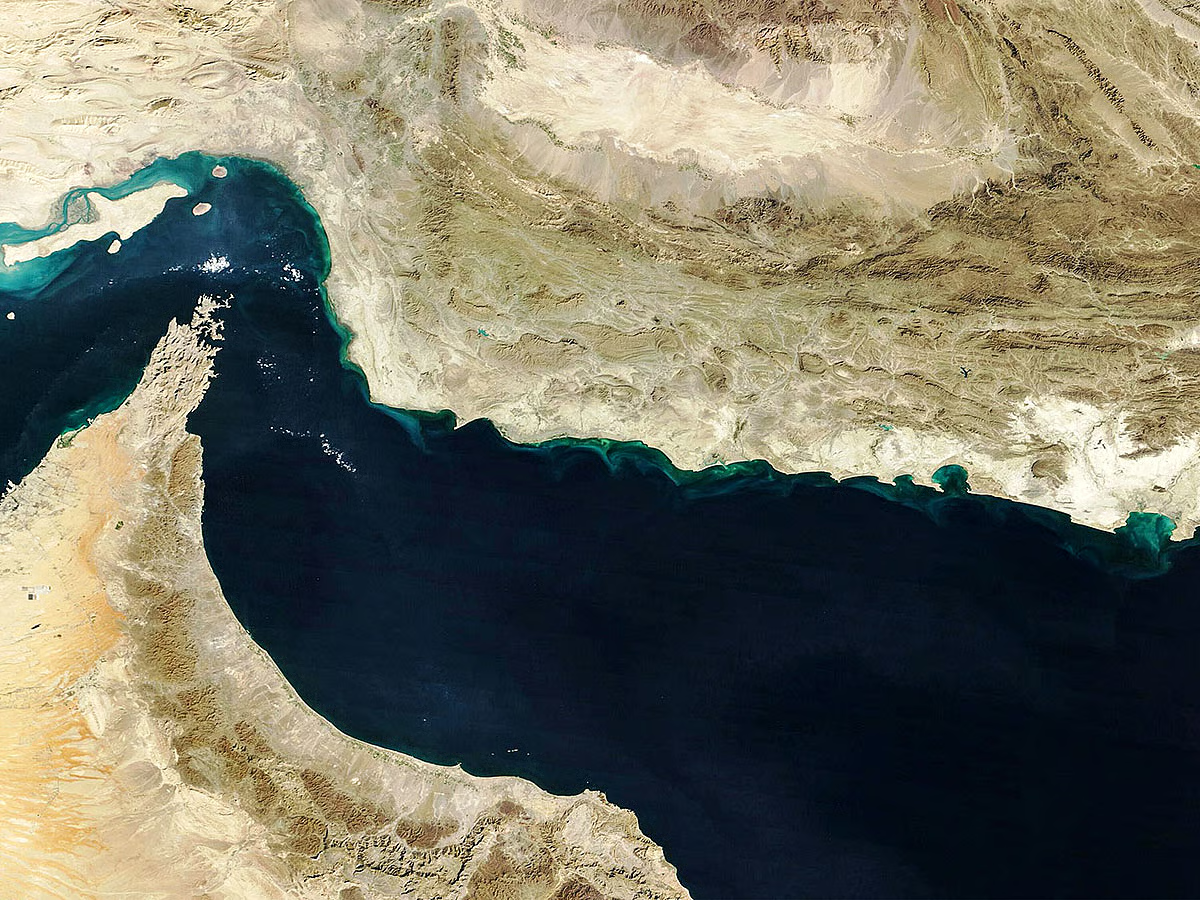
The situation is particularly sensitive in areas such as the Strait of Hormuz, a narrow waterway that is a critically important global maritime choke point linking the Persian Gulf with the Gulf of Oman, handling roughly 20% of global oil and LNG consumption (20-21 million barrels per day), according to the U.S. Energy Information Administration. It is the primary, indispensable route for oil exports from Saudi Arabia, Iran, UAE, Kuwait, and Iraq, making it crucial for global energy security and economic stability. Any disruption in this region has serious economic consequences, such as price rises and longer shipping times as companies use other routes to export oil effectively.
More than that, closure of the Strait of Hormuz and regional warfare has led to shipping companies avoiding the Red Sea, where the Suez Canal is located. Countries that have little to nothing to do with the U.S.-Iran conflict are being disproportionately damaged by its consequences; such as Egypt, which is largely dependent on the canal.
An interview was conducted with Arabic teacher Y.G (name redacted for privacy reasons). She explained the economic strain on Egypt from this issue.
Y.G stated that she “has a neighbor who is in trouble at this moment. She cannot get her blood pressure medication due to the war, putting her life at severe risk. She has not taken it for three days. These are the consequences of these strikes.”
Y.G also explained that Egypt is running out of natural gas due to the blockage of the Strait of Hormuz, and will not last long with the stores that they have.
Therefore, conflicts like these do not just affect Iran and the United States. They affect countries caught in economic, and sometimes literal, crossfire.
Humanitarian Concerns
Take the United Arab Emirates, for instance. Multiple Iranian strikes have hit the busy Dubai International Airport, pausing travel, and one person in the UAE has been killed as a result of strikes on surrounding buildings.
Another interview was taken with a contact close to the area in question. Interviewee D.S (name redacted for privacy reasons) explained that she “felt a bomb”, recalling the first day of the conflict. She also stated that “I saw two missiles falling, and felt three blasts. I live near the airport, and they [Iran] keep attacking the airport like continuously attacking the airport. And there was nothing all night. And they just woke up. I just felt three blasts…”
Casualties so far in the conflict have continued to rise. Up to 170 people (staff and students) were killed by a United States Tomahawk missile striking an Iranian school, according to Amnesty International. On the other side, six U.S. soldiers were killed in a refueling plane crash in Iraq.
The Future
As the conflict continues, its effects are being felt far beyond the borders of Iran and the United States. From economic disruption to humanitarian crises, the consequences highlight the global stakes of “regional” warfare/
With tensions still high and no clear end in sight, the U.S.-Iran conflict’s resolution remains to be seen. Only time can tell how this volatile issue in international politics will be resolved.
Sources
Afary, Janet. “Iranian Revolution (1979) | Summary, Causes, Effects, Islamic Republic, Ayatollah, and Facts.” Encyclopedia Britannica, 12 Mar. 2026, www.britannica.com/event/Iranian-Revolution. www.britannica.com/event/Iranian-Revolution.
Amid regional conflict, the Strait of Hormuz remains critical oil chokepoint – U.S. Energy Information Administration (EIA). www.eia.gov/todayinenergy/detail.php?id=65504.
BBC News. Why Did US and Israel Attack Iran and How Long Could the War Last? 13 Mar. 2026, www.bbc.com/news/articles/cx2dyz6p3weo.
Britannica Editors. “Iran Hostage Crisis | Definition, Summary, Causes, Significance, and Facts.” Encyclopedia Britannica, March 6, 2026. https://www.britannica.com/event/Iran-hostage-crisis. www.britannica.com/event/Iran-hostage-crisis.
Butler, Gavin. What is the Strait of Hormuz and why does it matter? 12 Mar. 2026, www.bbc.com/news/articles/c78n6p09pzno.
“Dreams of Flight and Service for 6 U.S. Military Members Killed in Iraq.” The New York Times, www.nytimes.com/2026/03/14/us/names-of-us-soliders-killed-tanker-crash.html.
Farley, Clare, et al. “How the Strait of Hormuz closure affects global oil supply.” Reuters, 11 Mar. 2026, www.reuters.com/graphics/IRAN-CRISIS/OIL-LNG/mopaokxlypa.
Joint Comprehensive Plan of Action Constitutes ‘Major Achievement of Nuclear Non-Proliferation’, Says Secretary-General on Implementation Anniversary | UN Meetings Coverage and Press Releases. 17 Jan. 2018, press.un.org/en/2018/sgsm18857.doc.htm?utm_source=chatgpt.com.
Samir, Mohamed, and Mohamed Samir. “Egypt’s Sisi Says Suez Canal Revenue Fell $10bn Due to Regional Instability.” Dailynewsegypt – Egypt’s Only Daily Independent Newspaper In English, 14 Mar. 2026, www.dailynewsegypt.com/2026/03/15/egypts-sisi-says-suez-canal-revenue-fell-10bn-due-to-regional-instability.
Staff, Al Jazeera. “US responsible for deadly attack on Iranian school: Amnesty International.” Al Jazeera, 16 Mar. 2026, www.aljazeera.com/news/2026/3/16/us-responsible-for-deadly-attack-on-iranian-school-amnesty-international.
—. “US responsible for deadly attack on Iranian school: Amnesty International.” Al Jazeera, 16 Mar. 2026, www.aljazeera.com/news/2026/3/16/us-responsible-for-deadly-attack-on-iranian-school-amnesty-international.
Stewart, Phil, and Idrees Ali. “Pentagon elevates investigation into Iran school strike.” Reuters, 13 Mar. 2026, www.reuters.com/world/middle-east/pentagon-elevates-investigation-into-iran-school-strike-2026-03-13.
“The US Withdrawal From the Iran Deal: One Year On.” SIPRI, 7 May 2019, www.sipri.org/commentary/expert-comment/2019/us-withdrawal-iran-deal-one-year.
What Are the Main US Military Bases in the Middle East? www.reuters.com/world/middle-east/us-military-facilities-middle-east-2026-02-28.

Leave a Reply